
A Child’s Question Is More Than a Moderation Label
A safer AI experience begins by understanding not only what a child said, but also who is asking, why they are asking and what could happen next.
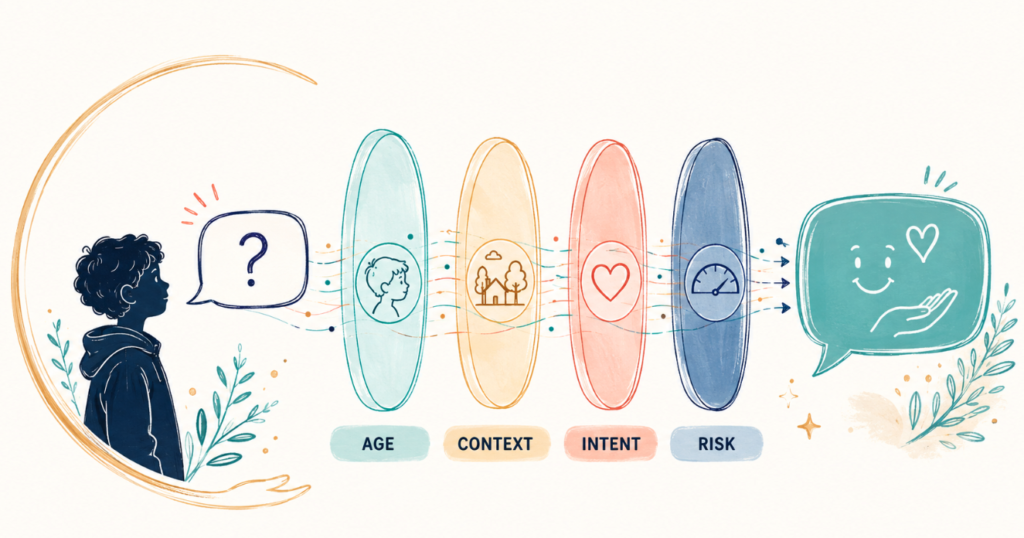
- the child’s age;
- the surrounding context;
- the child’s likely intent; and
- the level and immediacy of risk.
Labels identify content. Children need appropriate responses.
A moderation label can tell a system that a message relates to violence, bullying, self-harm, sexual content, emotional distress or another sensitive area. That is valuable—but it is only the beginning of the decision. Consider these questions:| Child’s message | What remains unknown |
|---|---|
| “Why do people faint?” | Is this a school question, or has someone just collapsed nearby? |
| “Someone keeps waiting for me after class.” | Is it a friend, repeated bullying, unwanted pursuit or an adult creating unsafe access? |
| “I don’t want to go back tomorrow.” | Is the child avoiding a test, experiencing anxiety or afraid of someone at school? |
| “How do I make this stop?” | What is happening, who is involved and is the child currently safe? |
1. Age changes what an appropriate answer looks like
Children do not form one uniform audience. A six-year-old and a seventeen-year-old may ask the same question but differ significantly in vocabulary, comprehension, independence and ability to act safely on advice. An age-aware response should adjust:- the words and sentence length used;
- how much detail is appropriate;
- whether an adult should be involved;
- the number and complexity of suggested steps;
- how uncertainty and risk are explained; and
- which actions the child can reasonably take without assistance.
2. Context reveals what the sentence alone cannot
A single message may be ambiguous. The recent conversation, location described, people involved and timing of an event can completely change its meaning. “There is smoke in the room” should not be treated like a general science question. “My friend said that yesterday, but they are safe now” is different from a live disclosure. “He keeps doing it” introduces repetition that may distinguish an isolated conflict from an ongoing pattern. Useful context can include:- whether the event is happening now, happened in the past or is hypothetical;
- whether the child is speaking about themselves or someone else;
- whether a pattern is repeated or a single event;
- whether an adult, older person or authority figure is involved;
- whether the child has access to immediate support; and
- what the system has already asked or advised in the current conversation.
3. Intent distinguishes curiosity from a request for action
Children explore difficult subjects for many reasons. They may be doing homework, processing something they saw, checking whether an experience is normal, trying to help a friend or considering an action themselves. The topic may be identical while the intent is different:- Learning: “What causes a panic attack?”
- Recognition: “Is this what a panic attack feels like?”
- Immediate support: “I think this is happening to me right now. What should I do?”
- Helping another person: “My friend is breathing really fast and looks scared. How can I help?”
4. Risk determines urgency—not just wording
Risk is more than the presence of a sensitive subject. It includes the likelihood, severity and immediacy of possible harm. A useful risk assessment asks:- Is anyone in danger right now?
- Has harm already happened?
- Is there a specific plan, method, threat or unsafe exposure?
- Does the child appear able to move to safety?
- Is another person controlling, pressuring or isolating the child?
- Would waiting for more information create unacceptable risk?
From one label to a layered safety decision
A child-safe AI system should treat classification as one signal in a larger decision process:- Understand the message: Identify the main subject and any independently supported safety signals.
- Apply the child profile: Adapt the response to the known age or age band without making unsupported assumptions.
- Use relevant context: Consider recent conversation and event timing while minimizing retained sensitive data.
- Assess intent and role: Determine whether the child is learning, disclosing, acting, witnessing or helping someone else.
- Evaluate risk: Consider severity, immediacy, access, repetition and uncertainty.
- Choose a response pathway: Educate, clarify, support, guide toward an adult or emergency resource, or refuse harmful assistance while preserving engagement.
- Validate the response: Check that the final answer is safe, age-appropriate, understandable and aligned with the detected risk.
What good child-safety reasoning looks like
A strong child-safe response should be:- Age-appropriate: understandable and actionable for the child’s developmental stage;
- Context-aware: responsive to what is actually happening, not merely the topic mentioned;
- Intent-sensitive: able to distinguish curiosity, disclosure, help-seeking and harmful action;
- Risk-proportionate: calm for low-risk questions and direct when urgent danger is present;
- Uncertainty-aware: willing to clarify rather than invent missing facts;
- Supportive: designed to keep the child engaged, especially during a difficult disclosure;
- Privacy-conscious: based on the least sensitive information required for safety; and
- Consistent: governed by explicit policies that can be tested, audited and improved.